
Reindeer Facts: Fascinating Insights About Santa’s Favorite Arctic Animals
When you think of reindeer, you might imagine snowy forests, Christmas sleighs, and the legendary Rudolph. But beyond their festive reputation, reindeer are fascinating creatures with incredible adaptations and a rich history in Arctic cultures. In this blog post, we’ll dive deep into some surprising reindeer facts that will make you appreciate these magical animals even more.
Reindeer, also known as caribou in North America, are some of the most iconic animals associated with the winter season, Arctic landscapes, and of course, Santa Claus’s magical sleigh ride. But beyond the festive stories and snowy postcard scenes, these creatures are truly remarkable. In this article, we’ll explore some surprising and little-known facts about reindeer—from their biology and behavior to their cultural importance in Lapland and beyond.
Reindeer Insights: Reindeer Are Found in More Places Than You Think
One of the most interesting reindeer facts is that they aren’t exclusive to Lapland or the North Pole. Reindeer, known as caribou in North America, are native to Arctic, subarctic, tundra, boreal, and mountainous regions across Europe, Siberia, and North America. In fact, they have one of the most expansive distributions of any land mammal!
Did you know?
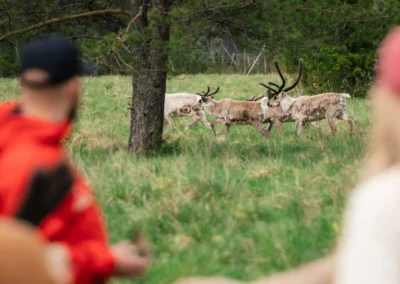
You can meet Lapland´s most iconic Arctic animals, the reindeer in two beautiful locations: Santa Claus Village and Taava Reindeer Farm. Roam freely, and explore our experiences with the reindeer!
1. Both Male and Female Reindeer Grow Antlers
Unlike most members of the deer family, both male and female reindeer grow antlers. Male reindeer typically shed their antlers in late autumn, while females keep theirs throughout the winter, which helps them to protect themselves while pregnant and babies when they are born.
2. Reindeer Eyes Change Color with the Seasons
Here’s a truly surprising fact: reindeer eyes change color! In summer, the light reflecting layer in their eyes (tapetum lucidium) is golden, and in winter, it shifts to a deep blue. This adaptation helps reindeer see better in the varying Arctic light levels throughout the year.
3. Reindeer Hooves Adapt to the Seasons
In the summer, reindeer have soft, spongy hooves ideal for gripping wet, boggy ground. But in the winter, the pads shrink, exposing the hard hoof rims that cut into ice and snow for stability.
4. Reindeer Migrate Further Than Any Other Land Mammal
Some reindeer herds travel over 5,000 kilometers a year, making them the most migratory land mammals on Earth. This long journey is a vital part of their survival, allowing them to access food and safer breeding grounds.
5. Reindeer Have Specialized Noses to Warm the Air
Reindeer noses are designed to warm up the freezing Arctic air before it enters their lungs. Their nasal passages are lined with complex turbinate bones that not only heat incoming air but also conserve moisture on exhalation.
6. Reindeer Play a Vital Role in Lapland Culture
In Finnish Lapland, reindeer are more than wildlife—they are part of the local economy, history, and identity. Reindeer herding is a traditional livelihood that still exists today.
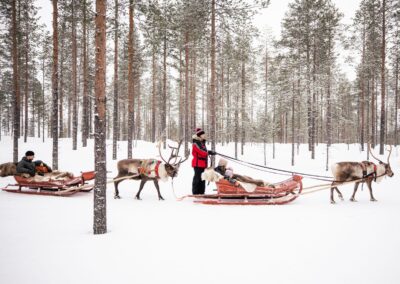
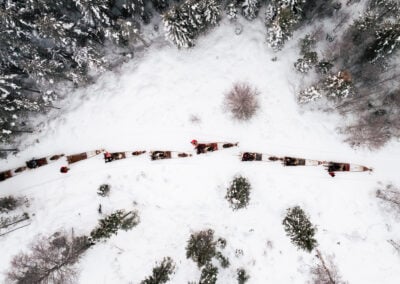
Visitors to Santa Claus Village in Rovaniemi can meet real reindeer, enjoy sleigh rides, and learn about the cultural significance of these gentle animals.
7. They Can See Ultraviolet Light
Reindeer can see ultraviolet (UV) light — something humans cannot. While our vision is limited to the visible light spectrum, reindeer perceive wavelengths beyond it, giving them a remarkable advantage in Arctic environments.
This ability helps them:
-
Spot predators like wolves against snowy landscapes. Fur that appears white or grey to humans often absorbs UV light, making predators stand out more clearly to reindeer.
-
Detect food such as lichen, which reflects UV light and becomes easier to distinguish beneath snow.
-
Navigate safely in Arctic glare conditions, where sunlight reflecting off snow can be blinding.
In a snow-covered environment that reflects up to 90% of visible light, UV vision is a life-saving advantage. During the long Arctic winter, when daylight is scarce and contrast is low, this enhanced perception helps reindeer interpret subtle visual differences in terrain, movement, and survival cues. It is one of the most extraordinary sensory adaptations found in mammals living in extreme climates.
8. Their Noses Are Built for Arctic Survival
Reindeer have highly specialized nasal passages designed to cope with some of the harshest temperatures on Earth.
Their nasal system:
-
Warms freezing air before it reaches their lungs.
-
Recovers heat when they exhale.
-
Moisturizes extremely dry Arctic air.
Inside the nose, an intricate network of blood vessels acts as a natural heat exchanger. As icy air is inhaled, it is warmed by body heat before entering the respiratory system. When the reindeer exhales, much of that warmth is recaptured, reducing energy loss.
This internal climate-control system allows reindeer to survive in temperatures that can drop below –40°C. Without such an efficient heat-exchange mechanism, breathing in Arctic winter would cause dangerous heat loss. Instead, reindeer conserve energy, a critical factor when food is limited and winter lasts for months.
9. Reindeer Milk Is Extremely Rich
Reindeer milk is one of the most nutrient-dense milks in the world, far richer than cow’s milk and even richer than many other Arctic mammals.
It contains:
-
Significantly higher fat content than cow’s milk.
-
More protein per volume.
-
Greater energy density overall.
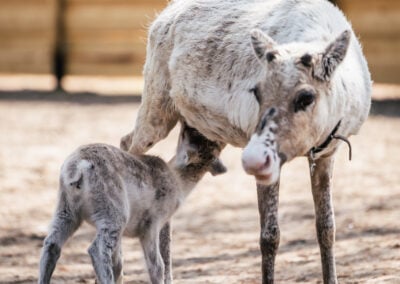
This richness plays a crucial role in calf survival. Reindeer calves are born into a short, intense summer season. They must grow quickly and build strength before winter returns. The high-energy composition of the milk supports rapid development in a harsh environment where time is limited and conditions are unpredictable.
In the Arctic, survival often depends on efficiency, and reindeer milk is a perfect example of how nature maximizes nutrition in extreme climates.
10. They Click When They Walk
Reindeer make a distinct clicking sound as they move — especially noticeable when a herd travels together.
This sound comes from tendons in their ankles slipping over bones with each step. Unlike vocal calls, the clicking is mechanical and consistent, creating a subtle rhythmic pattern as the herd moves across snow or tundra.
Scientists believe this adaptation may serve several important purposes:
-
Helping herd members stay together in low-visibility conditions such as snowstorms or polar twilight.
-
Maintaining awareness of nearby individuals during long migrations.
-
Possibly signaling health or strength within the herd.
In open Arctic landscapes where visibility can quickly disappear, this natural acoustic tracking system may help maintain group cohesion. It is yet another example of how reindeer are finely tuned to their environment, equipped not just with physical strength, but with subtle survival tools built into their anatomy.
Why Learning Facts Is Just the Beginning
Reading about reindeer is fascinating — but meeting them in real life is something entirely different.
Seeing how they move through snow.
Hearing the quiet crunch of hooves.
Feeling the peaceful rhythm of a sleigh ride.
That’s when these facts truly come alive.

0 Comments